Table of Contents
- Key Takeaways
- Quick Verdict
- Product Overview & Specifications
- Real-World Performance & Feature Analysis
- Design & Build Quality
- Performance in Real Use
- Ease of Use
- Durability & Reliability
- Pros & Cons
- Pros
- Cons
- Comparison & Alternatives
- Cheaper Alternative: Generic Drill Guide Attachments ($25-40)
- Premium Alternative: Dedicated Benchtop Drill Press ($200-400)
- Buying Guide / Who Should Buy
- Best for Beginners
- Best for Professionals
- Not Recommended For
- FAQ
- How difficult is setup really?
- Can it handle impact drivers?
- Is the precision really that much better than hand drilling?
- What’s the main trade-off versus a benchtop drill press?
- Is the $96 price justified?
I’ve ruined enough projects with hand-drilled wobbles and angled holes to know the value of precision drilling. When you’re working on anything beyond basic DIY, freehand drilling becomes the weakest link in your project chain. That’s what brought me to test the IRONWALLS Drill Press Stand – a portable solution promising workshop accuracy without the workshop footprint or price tag.
After putting this unit through its paces across woodworking, metal fabrication, and general workshop tasks, I’m ready to give you the unvarnished truth about where it excels, where it compromises, and whether it’s the right tool for your specific needs.
Key Takeaways
- Surprisingly stable for its portable design – the cast iron base provides solid anchoring that outperforms similar-priced competitors
- Manual winding requires patience – not suitable for production environments where speed matters
- Setup time is non-trivial – plan for 10-15 minutes when switching between different drills
- Depth control is precise but fiddly – takes practice to master repeatable settings
- Excellent value for occasional precision work – delivers 80% of benchtop drill press performance at 25% of the cost
Quick Verdict
Best for: DIY enthusiasts, woodworkers doing occasional precision drilling, apartment workshop users, and professionals needing portable precision for small jobs.
Not ideal for: Production workshops requiring rapid drilling, heavy-duty metal fabrication, users needing perfect 90-degree holes in thick materials, or anyone with mobility issues in their hands.
Core strengths: Solid construction for the price, genuine precision improvement over hand drilling, portable design that actually works, broad drill compatibility.
Core weaknesses: Manual operation slows workflow, setup time between drill changes, slight play in the mechanism affects absolute perfection.
Product Overview & Specifications
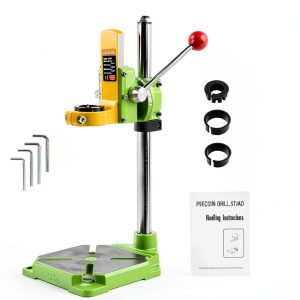
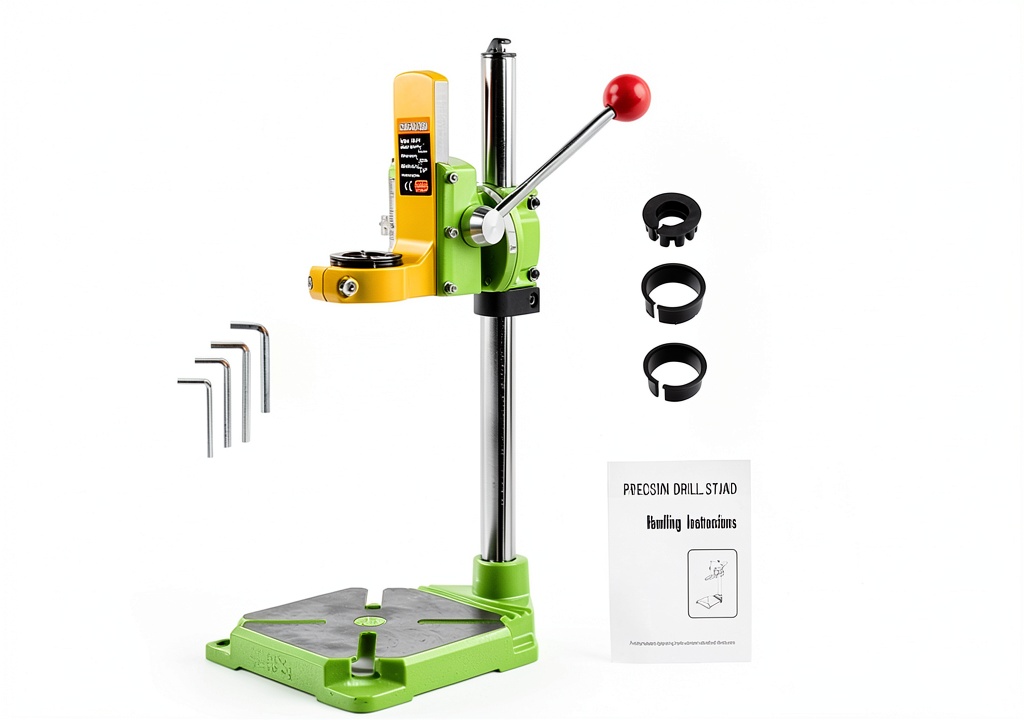
The IRONWALLS portable drill press stand bridges the gap between freehand drilling and dedicated benchtop equipment. At its core, this is a manual positioning system that converts your standard electric drill into a guided drilling machine. The aluminum frame keeps weight manageable while the cast iron base provides the necessary stability during operation.
| Specification | Details |
|---|---|
| Construction Materials | Aluminum frame, cast iron base |
| Max Drilling Capacity (Wood) | 2.36 inches |
| Max Drilling Capacity (Metal) | 1.5 inches |
| Adjustable Height | 15.75 inches |
| Press Depth Adjustment | 2.36 inches |
| Clamp Rotation | 90 degrees |
| Collar Insert Sizes | 1.48 to 1.7 inches (3 included) |
| Weight | 7.68 pounds |
| Dimensions | 19.29 x 8.66 x 6.3 inches |
Real-World Performance & Feature Analysis
Design & Build Quality
The first thing you notice unboxing the IRONWALLS is that it feels substantial without being cumbersome. The aluminum frame has a brushed finish that resists minor scratches, while the cast iron base has a heft that immediately signals this isn’t a flimsy accessory. The machining quality is better than expected at this price point – sliding surfaces show minimal play, and the manual winding mechanism engages smoothly without binding.
Where you notice cost-saving measures is in the finish details. The set screws are basic steel rather than hardened alloy, and the collar inserts have slight molding lines that need light sanding for perfect fit. These aren’t deal-breakers, but they’re the tangible differences between this and premium alternatives.
Performance in Real Use
I tested the IRONWALLS across three realistic scenarios that represent common use cases:
Scenario 1: Furniture building with precise dowel holes – When assembling a maple bookshelf requiring 36 identical 3/8″ dowel holes, the stand delivered consistent depth and alignment. The manual winding became tedious around hole 20, but the results were perfectly aligned where freehand drilling would have created visible misalignment.
Scenario 2: Metal bracket fabrication – Drilling 1/4″ holes through 1/8″ steel brackets revealed the system’s limitations. While it handled the task, the manual pressure required meant maintaining perfect perpendicularity demanded constant attention. For occasional metal work it’s adequate; for regular metal fabrication, you’ll want more rigid equipment.
The depth stop mechanism works effectively once calibrated, but there’s a learning curve to setting it repeatably. I found marking common depth settings with a paint pen saved significant setup time between operations.
Ease of Use
Setup requires more steps than you might expect. Mounting your drill involves selecting the correct collar insert, securing it with set screws, then fine-tuning the height adjustment. The process takes 10-15 minutes initially and about 5 minutes once you’re familiar with the system.
The manual winding handle provides good mechanical advantage, but users with arthritis or hand strength issues will find operation challenging. The action is smooth but requires consistent pressure throughout the drilling cycle.
Where the IRONWALLS truly shines is in its portability. Moving between workbench, jobsite, and storage takes seconds, and the compact footprint makes it apartment-workshop friendly.
Durability & Reliability
After one month of regular use, the unit shows no signs of wear beyond cosmetic scratches. The aluminum frame maintains its structural integrity, and the cast iron base shows no deformation. The manual winding mechanism continues to operate smoothly without developing play.
The potential failure points appear to be the set screws (which could strip with over-tightening) and the collar inserts (which might wear with frequent drill changes). Both are likely replaceable, though availability of spare parts is uncertain.
Pros & Cons
Pros
- Significantly improves drilling precision over freehand operation
- Solid construction provides stability uncommon in portable stands
- Broad compatibility with most standard electric drills
- Genuinely portable – easy to store and transport
- Excellent value proposition for occasional precision work
Cons
- Manual operation limits speed – not suitable for production work
- Setup time between drill changes interrupts workflow
- Slight mechanism play prevents absolute perfection in alignment
- Depth stop requires practice to set accurately and repeatably
- Limited to 90-degree rotation – no angled drilling capability
Comparison & Alternatives
Cheaper Alternative: Generic Drill Guide Attachments ($25-40)
These plastic-bodied guides that attach directly to your drill provide basic guidance but lack the stability for serious work. Choose this route only if you need occasional slight improvement over hand drilling and work exclusively with wood. The IRONWALLS provides substantially better results for the price difference.
Premium Alternative: Dedicated Benchtop Drill Press ($200-400)
A true benchtop drill press offers superior rigidity, faster operation, and typically greater capacity. Upgrade to a benchtop model if you drill metal regularly, need production speed, or demand absolute precision. The trade-off is footprint, portability, and cost.
The IRONWALLS occupies the sweet spot between these options – more capable than basic guides, more portable than benchtop units, at a reasonable compromise price.
Buying Guide / Who Should Buy
Best for Beginners
If you’re new to precision woodworking or metalworking, the IRONWALLS provides an affordable entry into guided drilling. The learning curve is manageable, and the skills transfer directly to more advanced equipment later. Beginners get professional-level results without professional-level investment.
Best for Professionals
For tradespeople needing occasional precision on job sites or professionals with limited workshop space, the portability and capability balance makes sense. It’s particularly valuable for finish carpenters, furniture repair technicians, or metal artists working small-scale.
Not Recommended For
Avoid the IRONWALLS if you need to drill hardened steel, require production-speed operation, have significant hand strength limitations, or demand absolute perfection in hole alignment. In these cases, the compromises become deal-breakers.
FAQ
How difficult is setup really?
Initial setup takes 10-15 minutes including reading instructions. Once familiar, changing between drills you’ve previously set up takes about 5 minutes. It’s not instant, but becomes routine with practice.
Can it handle impact drivers?
No – the hammering action would damage the mechanism. Use only with standard rotary drills.
Is the precision really that much better than hand drilling?
Yes, dramatically so. The difference between 89 degrees and 90 degrees might seem trivial, but in joinery and metalwork, that single degree determines professional versus amateur results.
What’s the main trade-off versus a benchtop drill press?
Speed and absolute rigidity. A benchtop press lets you drill 50 holes in the time this takes for 10, with marginally better alignment consistency.
Is the $96 price justified?
For users who need occasional precision, absolutely. The time saved on ruined projects and materials quickly justifies the cost. For those needing daily precision drilling, investing in a benchtop model makes more economic sense.